
Statement of Operational Assurance 2025 – 2026
Introduction
The York and North Yorkshire Combined Authority (YNYCA), in its capacity as Fire and Rescue Authority, has carried out its functions in accordance with the defined statutory and policy framework in which it is required to operate. As such, the view at the end of the 2025–26 financial year is that requirements associated with operational matters have been met.
The key areas of statutory law and non-statutory guidance documents setting this out are:
- The Fire and Rescue Services Act 2004
- The Civil Contingencies Act 2004
- The Regulatory Reform (Fire Safety) Order 2005
- The Fire and Rescue Services (Emergencies) (England) Order 2007
- The Localism Act 2011
- The Fire and Rescue National Framework for England
- The Health and Safety at Work etc. Act 1974
The Fire and Rescue National Framework states that Fire and Rescue Authorities must make provision to respond to incidents such as fires, road traffic collisions and other emergencies within their area, and in other areas in line with their mutual aid agreements and reflect this in their Community Risk Management Plan (CRMP).
Risk and Resource Model
The Service is now operating under its refreshed strategic planning arrangements, transitioning from the Risk and Resource Model (RRM) 2022–2025 into the Community Risk Management Plan (CRMP) 2025–2029.
The CRMP is informed by a robust evidence base, including consultation with over 1,600 residents, stakeholders and partners, and reflects a continued commitment to aligning resources with risk and demand across York and North Yorkshire.
The Service continues to apply the core CRMP planning principles established through consultation, including dynamic resourcing, risk-based prevention, workforce safety, value for money, and collaborative working.
Fire and Rescue Plan 2025–29
The Fire and Rescue Plan (FRP) 2025-29 was informed by over 1600 responses to the York and North Yorkshire Mayor’s consultation. It sets out the Mayor’s six strategic priorities for the Service.
1. Targeted Prevention
Deliver targeted prevention activities to keep people in York and North Yorkshire safe from fires, road traffic collisions, water hazards and other emergencies.
2. Protected Built Environment
Provide targeted support and advice to protect people and properties from fires through safer buildings in York and North Yorkshire.
3. Effective Emergency Response
Provide an effective response to incidents across York and North Yorkshire, as quickly as possible.
4. Stronger Communities
Prepare for major disruptions, working in collaboration with our partners to support communities across York and North Yorkshire to effectively prepare for and recover from emergencies.
5. Supported, Safe and Skilled Staff
Foster a culture of excellence and belonging in North Yorkshire Fire and Rescue Service. Invest in training, safety and welfare to maintain a skilled and resilient Workforce.
6. Financial Stability
Ensure the long-term financial sustainability of North Yorkshire Fire and Rescue Service and be transparent in our spending.
Within the FRP consultation, we introduced seven CRMP planning principles. These principles were endorsed by the public, via the Mayor’s consultation and set out high level objectives for consideration, when drafting our new CRMP. It is the intention of the CRMP to address the priorities set out within the FRP and the planning principles set out below:
- Dynamic resourcing: On a daily basis we will ensure our fire engines are in the best place to meet demand and risk, providing the best possible response times to emergencies across the whole of York and North Yorkshire.
- Protect our communities: We will keep prevention and protection at the forefront of our activities, targeting people and buildings most at risk, as well as areas where response times are unavoidably longer.
- Safety focused: We will ensure we have the right people, in the right places, with the right skills, equipment and training to do their jobs effectively and safely.
- Value for money: We will use our money wisely to ensure we are sustainable now and in the future.
- Support our on-call Firefighters: Continue to work with our on-call Firefighters to maximise the availability of our fire engines, improving how we recruit, retain and recognise them.
- Collaborative working: We will maintain and seek collaboration opportunities with partner organisations to deliver effective, joined up interventions and a better service to our communities.
- Service delivery: We will ensure our operating model (how we deliver our services) is both productive and aligned to the risk presented across York and North Yorkshire.
Community Risk Profile
The resources that we put in place are based on an assessment of risk across the Service area. We call our assessment of risk the Community Risk Profile (CRP), which was updated in 2025 to provide the evidence base for the new Community Risk Management Plan (CRMP) 2025–2029. A CRP is a comprehensive assessment carried out by a Fire and Rescue Service to identify and evaluate the various risks within their community. This profile enables each service to understand both current and potential future risks that could impact residents, workers and visitors in the area. Key components of a CRP include identifying all foreseeable fire and rescue related risks, such as accidental dwelling fires, road traffic collisions and water-related incidents.
It involves examining population density, age and other demographic factors to determine who is at risk and why. The assessment also considers the physical characteristics of the area, including urban and rural differences and analyses socio-economic factors to identify areas with higher vulnerability. Reviewing past incidents helps predict and prepare for future risks. We must also consider the impact of climate change and other environmental factors.
We have worked with Operational Research in Health Limited (ORH) who have undertaken a review of future Community Risk and Response Modelling, whilst validating the data and analysis undertaken from our previous Community Risk Profile. The National Fire Chiefs Council (NFCC), in collaboration with ORH, produced a methodology for dwelling fire risk categorisation as part of NFCC’s Definition of Risk project.
This methodology alongside ORH’s analysis of the risk of being killed or seriously injured on the roads in York and North Yorkshire, provides us with a data-driven approach to understanding the risks within our communities. NFCC and ORH have produced a report on the likelihood, consequence and risk of road traffic collisions (RTCs). The NFCC project required multiple data sources, which enabled us to define the likelihood of RTCs by type of road.
We have also considered the National Risk Register and the Community Risk Register created by the North Yorkshire Local Resilience Forum (NYLRF) which is a partnership of local agencies working together to manage emergencies covering the whole of North Yorkshire and York.
Community Risk Management Plan
Each fire and rescue authority has a statutory duty under the Fire and Rescue National Framework for England to produce a Community Risk Management Plan (CRMP). We have now developed our new CRMP 2025–2029, informed by the Community Risk Profile (CRP), which sets out the key challenges and risks facing our communities and how we intend to meet and reduce them. The CRMP demonstrates how our prevention, protection and response activities will be used collectively to prevent and/or mitigate fires and other incidents across York and North Yorkshire.
The CRMP 2025–2029 includes wider strategic objectives which describe the actions we are taking to improve our service and provides a clear link between the work we do to make our communities safer and the improvements we make as an organisation and employer. The plan has been shaped through public consultation and partner engagement, and the agreed areas of focus will be assessed and prioritised through our service planning and performance frameworks to inform delivery over the four-year period. We will report progress to the public periodically through the Deputy Mayor’s Online Public Meetings (OPM), supported by an annual published update on delivery and outcomes.
Operating Context
Our Service area is one of the largest in England covering more than 3,200 square miles and over 6,000 miles of road. Our area has isolated rural settlements and farms, market towns, and larger urban areas such as York, Harrogate, and Scarborough. The geographical area is incredibly diverse. It is both highly connected and urban, with the city of York at its centre and distinct towns, but also deeply rural with many isolated communities
The road network is the main means of transport connecting small towns and villages. The rural nature of our area means that people often travel further to access work, education, and services. Several major arterial routes also cross our area – the A1(M), M62, A59, A64, A65, A66 and A19.
Two of the major rivers in the county are the River Swale and the River Ure, joining together to form the river Ouse which flows through York. The coastline of North Yorkshire runs for approximately 45 miles from just north of Whitby to south of Filey. York and North Yorkshire includes high-quality landscapes with two national parks (North York Moors and the Yorkshire Dales) and three National Landscapes (Howardian Hills, Nidderdale and the Forest of Bowland).
Alongside these geographical features, environmental risk is increasing. Across the fire and rescue sector, flooding and wildfires are becoming more frequent and more severe, placing growing pressure on operational capacity and resilience arrangements. For a large and predominantly rural service such as ours, these risks are particularly significant: dispersed communities, long travel distances and limited access routes can extend response times, while extensive areas of moorland, farmland and woodland can increase the likelihood and scale of wildfire incidents and the consequences of prolonged dry periods. Flooding similarly creates complex, multi‑site demand across wide areas, impacting transport routes and requiring sustained multi‑agency response.
The wildfire risk was prevalent for NYFRS during 2025-26 when we responded to one of the largest wildfires ever. The Langdale Fylingdales major incident fire had a significant and lasting impact across North Yorkshire, placing sustained pressure on emergency response arrangements, land management, infrastructure, the local economy and recovery activity. It highlighted the strong interdependencies between organisations across all phases of a major wildfire and reinforced the importance of effective coordination, a shared understanding of risk, proactive prevention and robust collective assurance.
There are approximately 830,000 residents in York and North Yorkshire, 61% of which are of working age. York has a strong student base, due to the presence of two universities. The population is primarily of an older demographic with 24% of residents aged 65 and over, compared with a national average of 18%. Some of our neighbourhoods are among the 20% most deprived in England. Most of these are in Scarborough, but six are also within York, two in Craven and single neighbourhoods in Selby and Harrogate.
In 2026–27, the Service continues to operate within a constrained financial environment, with ongoing pressures from inflation, significant reductions in national funding and increased employer costs. As a result, there is a sustained requirement for improvements to be innovatively generated and clearly prioritised, with strong leadership and accountability for delivery. The focus remains on redesigning how we work, maximising the benefits of collaboration, technology and data‑led decision making, rather than relying solely on financial reductions. Investment decisions will be carefully targeted to ensure demonstrable value for money, measurable improvements in productivity and a sustained positive impact on service delivery and community outcomes.
Prevention
HFSV completion rates have continued to grow significantly during 2025-26. The graph below shows the year-on-year increases in activity from the service.
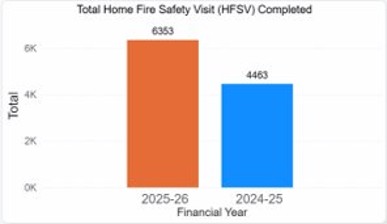
The increase from 4,463 completed HFSVs in 2024-25 to 6,317 in 2025-26 represents a 42% growth in activity, clearly illustrating the enhanced effectiveness of investment in prevention resources during the RRM 2022-25 period.
To ensure efficiency and alignment of activity to risk, the risk rating of HFSV’s has been evaluated. The number of High and Very High Risk HFSVs completed has increased by 31% between 2024-25 and 2025-26, reflecting both an increase in activity but also improved risk targeting.
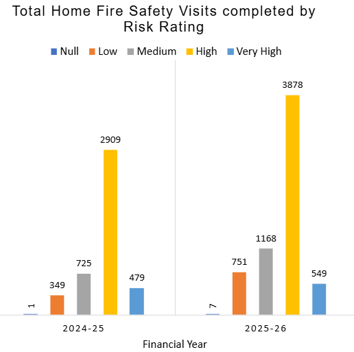
Post‑incident Home Fire Safety Visits increased by 37% following the introduction of the Post Incident Engagement Policy and enhanced focus from operational teams.
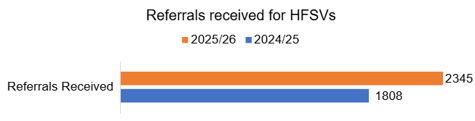
A key factor in improving the productivity of prevention work has been the quality and quantity of referrals from and to partner agencies. Partnership referrals represent one of the most efficient ways of identifying high risk residents in our communities for targeted interventions. 2025/26 has seen a significant increase in the numbers of referrals made by partners (a year-on-year increase of 30%).
During 2025/26, NYFRS introduced the Developing Resilience Programme (DRP) to support children and young people who may be vulnerable, experiencing wellbeing challenges, or at risk of harm. The programme combines fire and rescue‑based activities with structured life‑skills sessions to help participants build resilience and confidence, improve coping skills, make safer choices, and reduce risk‑taking behaviours. The first cohort was delivered in November 2025, followed by a further delivery in early 2026, with 14 young people completing the course.
Protection
The Service continues to fulfil its statutory responsibilities to protect the built environment through a combination of enforcement, audit, advisory activity and timely statutory consultation. During 2025/26, protection activity has remained aligned to risk through the continued implementation of the Risk Based Intervention Programme, ensuring that inspection, enforcement and business engagement are targeted toward the highest-risk premises and those where the potential consequences of fire are greatest.
Performance during the year indicates that this approach is delivering improved assurance and productivity. Statutory and non-statutory consultations increased, with performance in building and licensing consultations remaining consistently high and within required timeframes. Business engagement activity has also strengthened, including increased guidance and advice to responsible persons, continued support through Primary Authority arrangements, and enhanced follow-up where unwanted fire signals indicate the need for improved compliance and risk management.
The Service has also strengthened its protection capability through improvements to out-of-hours provision and a more structured approach to compliance and enforcement. Taken together, these measures demonstrate that protection resources are being used more effectively, that regulatory activity is increasingly aligned to risk, and that the Service continues to improve both public safety outcomes and value for money.
This improved capability is also reflected in the increased delivery of fire safety checks and the wider development of operational staff. During 2025/26, fire safety checks increased significantly following the introduction of the revised Risk Based Intervention Programme and the commencement of the Level 2 Fire Safety Check approach, enabling operational managers and trained crews to undertake lower-risk fire safety interventions in regulated premises.
| Activity | 2024/25 | 2025/26 | % Change |
| Fire Safety Check | 27 | 387 | +1333% |
This has strengthened the Service’s ability to gather risk information, reinforce prevention and protection messages, and support earlier identification of premises requiring further intervention. The expansion of Level 2-trained personnel has enhanced the Service’s ability to conduct a wider array of protection activities, strengthen station resilience, and optimise the deployment of both wholetime and on-call resources. Importantly though, specialist Business Fire Safety Officers were responsible for completing 89% of all fire safety tasks throughout 2025/26.
Resilience
NYFRS maintains resilience through a combination of local, regional and national arrangements designed to provide additional capacity during periods of sustained or exceptional demand. This includes established mutual aid arrangements under sections 13 and 16 of the Fire and Rescue Services Act 2004 with neighbouring and regional fire and rescue services, alongside the maintenance of national resilience capabilities and assets. These arrangements are a core part of the Service’s resilience model and ensure that support can be requested, received and integrated in a structured and timely way when local capacity is under pressure.
The effectiveness of these arrangements was demonstrated clearly during the Langdale/Fylingdales wildfire, one of the most significant incidents faced by the Service in 2025/26. Following the escalation of the incident and major incident declaration on 13 August 2025, neighbouring services provided immediate support through sections 13 and 16 mutual aid arrangements, both on the incident ground and through the backfilling of stations to maintain countywide resilience. During the main wildfire period, the Service continued to respond to 453 additional incidents across York and North Yorkshire, supported by 41 regional mutual aid resources. As the incident became increasingly protracted, a formal National Resilience request was made on 27 August 2025 to provide additional support, specialist capability and rest periods for NYFRS crews. This demonstrated not only the strength of local and regional collaboration, but also the Service’s ability to access and integrate national resilience arrangements in a timely and effective manner during a prolonged major incident.
Response
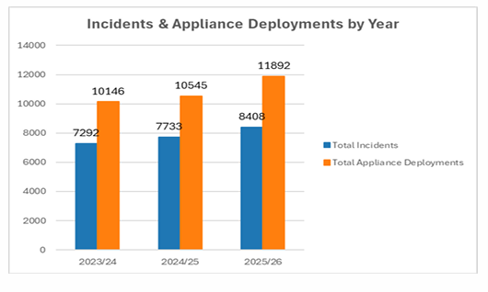
The Service continues to deliver an effective emergency response across a wide range of incident types and in the context of increasing demand. During 2025/26, the overall number of incidents attended increased by 8% compared with the previous year and appliance deployments increased by 13%, reflecting sustained pressure on operational capacity across York and North Yorkshire.
In 2025/26, the Service experienced an 8% rise in the total number of incidents attended compared to the previous year, with appliance deployments also increasing by 13%. This indicates an increased demand on operational resources throughout York and North Yorkshire.
Despite this increased demand, the Service continued to meet its consulted response standards during the year. The average response time to all incidents was 12 minutes 15 seconds against the 13-minute standard, and the average response time to dwelling fires was 10 minutes 52 seconds against the 11-minute standard. This provides assurance that frontline response arrangements remained effective, proportionate and aligned to risk across a large and predominantly rural service area.
This performance has been supported by continued improvements to the Service’s response model and command-and-control arrangements. At Harrogate, the introduction of the day-crewed second appliance in place of the Tactical Response Vehicle improved second-appliance availability from 73.94% to 97.08%, with no deterioration in first-appliance response performance and stronger mobilisation resilience.
In Control, the function underwent full restructure and a change of duty system during 2025/26. This change has reduced variance in crewing levels, added resilience and increased the amount of time that minimum staffing levels of 3 are maintained.
Productivity and Efficiency
The Service continues to exceed national expectations in relation to productivity and efficiency, as set out in the Productivity and Efficiency Plan.
During 2025/26, NYFRS has demonstrated significant increases in productivity, particularly within prevention activity, while maintaining operational performance.
The Service has adopted a structured approach to improving productivity through the use of data, digital tools and process improvement, ensuring that outputs are maximised within existing resources.
This approach reflects the continued requirement to deliver efficiencies while maintaining or improving service outcomes.
Collaboration
Collaboration remains a key enabler of service delivery, organisational resilience and value for money. During 2025/26, the Service continued to work closely with North Yorkshire Police and other partners through shared services, co-location of buildings, and joint operational and support functions. This collaborative model continues to support interoperability, reduce duplication and strengthen the sustainability of core enabling services across both organisations.
During 2025/26, this was complemented by restructures across support services designed to improve resilience, clarify accountability and make more effective use of resources. The Service continued to operate a number of enabling functions on a shared basis with North Yorkshire Police, including IT, People Services, Payroll, Finance, Fleet, Estates, Logistics and Procurement, while reviewing structures and critical roles to reduce single points of dependency and strengthen succession planning. These changes have supported a more sustainable operating model, better aligned support to frontline delivery, and improved the Service’s ability to deliver efficiency and organisational improvement alongside day-to-day operational demands. Partnership working has also continued to strengthen in service delivery areas, including prevention activity where increased referrals and improved joint working with partner agencies have supported more targeted interventions.
Organisational Assurance
The Service has further developed its internal assurance arrangements to provide comprehensive oversight of operational performance.
Performance is monitored through structured governance arrangements, including monthly and quarterly performance reviews, supported by Power BI dashboards and regular reporting.
A formal performance audit process is in place, aligned to HMICFRS inspection criteria, assessing performance across prevention, protection, response, efficiency and people.
In addition, incident monitoring, training observations and organisational learning processes ensure that lessons are identified and improvements are implemented systematically.
Performance Indicators
Performance is scrutinised across all operational areas, including response standards, prevention, protection, training compliance, risk information and workforce indicators.
This information is reported publicly through Online Public Meetings and supports transparency and accountability to the communities served.
His Majesty’s Inspectorate of Constabulary and Fire & Rescue Services (HMICFRS)
The Service continues to make progress against areas for improvement identified in previous HMICFRS inspections.
Significant work has been undertaken to strengthen governance, performance management and operational delivery, and the Service remains committed to ongoing improvement ahead of future inspections.
Conclusion
Taken together, the evidence set out in this statement demonstrates that North Yorkshire Fire and Rescue Service has continued to deliver its statutory responsibilities effectively during 2025/26, while adapting to increasing demand, changing risk and a constrained financial environment. Across prevention, protection, response and resilience, the Service has maintained performance, strengthened productivity and continued to align its operating model to the risks and needs of the communities it serves.
- Delivering prevention, protection and response activity that is increasingly targeted, evidence-led and aligned to community risk
- Maintaining response standards and service resilience despite rising incident demand, major incident pressures and the challenges of a large and predominantly rural service area
- Strengthening organisational assurance, governance and performance management to support transparency, accountability and continuous improvement
- Improving productivity, efficiency and workforce capability through better use of data, redesigned operating arrangements and targeted investment in areas of greatest impact
Accordingly, the Authority can be assured that the Service has met its operational requirements during 2025/26 and has continued to deliver an effective, resilient and value-for-money service to the public. The evidence within this statement also demonstrates that the Service is not only maintaining statutory compliance, but is actively improving how it deploys resources, manages risk and provides assurance in support of safer communities across York and North Yorkshire.